Kingdom of Cambodia is situated in Southeast Asia, bordered to the North by Thailand and Laos, the East and the South by Vietnam and the West by the Gulf of Thailand. The country is completely based on agriculture in which they collect the harvest during the whole year: - Long Term Rice in rainy season - Short Term Rice in dry season where the fields is near by is the irrigation canal system.
Cambodia has also the farm –land along the both sides of Mekong and Tonle Sap River where they plant corn, potatoes, cucumber and much other different kind of vegetables. We plant as well the tree-fruit like banana, mango, jackfruit, sugar-cane, milk-apple, durian, etc…. Besides all above, Tonle Sap Lake is the largest fishy-regio9n in Asia. Kingdom of Cambodia has rubber, teak wood, timber and all kind of best quality wood for furniture. Country name : Kingdom of Cambodia Land : 181.035 km Motto : Nation- Religion- King Capital : Phnom Penh International Airport : Phnom Penh and Siem Reap Languages : Khmer, secondarily English and French Ethnic Groups : Khmers, Chinese, Vietnamese, Khmer Islam ( Chams ) : Hill-tribes in the northeast. Religion : Theravada Buddhism (97%) Population : 14 million Currency : Riel (Us$1=4000R) Location : Southeast Asia Time : GMT+ 7hours Business Hours : 7:30-11:30 / 2:00-5:00 Voltage : 220v / 50Hz
|
Bonn Chaul chhnam Thmey - Khmer New year The Cambodian New Year spans three days following the end of the havest season. Khmer people clean and decrate their house with alters for offering. Then they play tranditional games such as Boes Angkunh, Leak kanseng... and dancing in the group.
|
Sprits commemoration festival The Spirits Commemoration Festival is held for the spirits of the dead. For Bonn Dak Ben,food is offered to monks for 15 days. On the 15th day of the ceremony, the full moon is called Bonn Phchom Ben, the collection of the Bens (offerings). During this celebration,if departed souls do not find their family making offferigs at a pagoda, it is believed that the soul will curse and bather the descendent throughout the year.
|
The water Festival The water and Moon festival marks the reversing of the current in the Tonle Sap and Tonle Chatok Mok river.the hightlight of this three day festival draws tens of thousands of khmer people to the river banks to watch long boat races, fire works and a lighted floilla boats under the full moon.
Siem Reap Has its own Water Festival in November, on the same dates. It is a major event. attracting tens of thousands of Khmers for the Boat racing. The racing is held on the river close to Bopha Angkor hotel . Like Phnom Penh, the waterfront is transformed by night into a glittering display of illuminations with a spectacular firework display.
|
Buddhism : The Buddhist religion adheres to the basic principles of non-violence, compassion, and generous works.
Mahayana Buddhism: The 'Greater Vehicle'; a school of Buddhism that extended the early teachings; flourished in Cambodia, particularly in the late 12th and early 13th centuries.
Khmer: Ancient indigenous people of Cambodia, as well as the language of Cambodia.
Hinduism: Religion and social system of the Hindus. Hinduism was especially popular in Cambodia especially from the first century to the 12th century.
Bonn Kathen - Religious Festival:This 29 days religious festival is marked by town and counry folks marching in procession to the pagodas (wat) where monks are waiting to change the their old saffrom robes for new ones offering during the festival.
|
Traditional arts and crafts are abundant in Cambodia. Sculptures, paintings and curving done with great care and attention. One can view such antiquities in market places, shop or museum.The variety of arts and crafts are large in range and include such item as: silver and gold jewelry, wicker were furniture, fine hard wood furniture, silks, marble sculptures, high quality China, leather were and much of the products will be intricately carved especially the furniture, sculptures etc. Unfortunately, much of these works completely ceased to during the Khmer Rouge dictatorship. Artisans ware forced to work in labor camps, where most of then painful deaths. Many arts and crafts also purposely. Today there has been a revival, due to a great dearly restoration work, which has been initiated by foreign governments. Now many centers have been established to keep the ancient methods of the craftwork alive. You can see examples of this throughout the country.
|
Mountains and Plains Most Cambodia consists of a basin shaped lowland area, enclosed by the mountain chains to the north, east, and the west. The Cardamom range in the Southwest contains Cambodia's highest peak, Phnom Aoral, which stands at 5.948 feet (1.813 meters). The Dangrek range marks a natural border with Thailand. Dense tropical forests cover most of the mountain. Their ongoing rapid deforestation is meanwhile of international concern.
|
Season The climate of Cambodia is typically hot and humid all year round. Monsoon brings dramatic changes in the rainfall, creating the two seasons: a wet season and a dry season. Between 75 and 80 percent of total annual rainfall is brought by the Southwest monsoon between May and October. The arrival of the Northeast ushers in the harsh dry season. The average temperature is 28 Celsius, but it is cooler in the highlands. The temperature can be also a few degrees in the lowland during the dry season. We have only two distinguished seasons: the rainy season from May to October, the dry season from November to April with 25 to 35 degrees C. Sometimes reaches 39 degrees C in late April. The best time for a visit to Cambodia is from November to January with only 201 to 30 degrees C. In the Northeast, the mountainous region with beautiful evergreen landscape where many different ethnic minority living in.- Rainy Season: May - October
- Dry Season: November - April
|
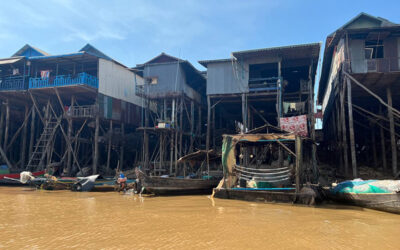
Those enchanted by rice paddies and water buffalo, stilt-houses and little villages, will find a tour through the Cambodian country side a worthwhile cultural experience. The road from Siem Reap to the Tonle Sap Lake is particularly picturesque, follwing the Siem Reap River past traditional Khmer houses, pagodas, water wheels and other sites of interst.
|
Rice Several month of hard labor go into providing Cambodian supper tables with their most important food-rice. Famers have to break up the hard ground during the dry season of the year and plough it with the first drops of rain. Rice seedlings are first planted in one part of the field, where they grow while the farmer cultivates and prepares another part of the field in which the rice will be transplanted at the start of the heavy rain season. Weeds and pests attack the rice fields all summer. Hoppers, rice bugs, field crabs, mice, and herons keep the farmers busy. After the rains comes the harvest, followed by the exhausting job of threshing, winnow wing, and milling the rice grains. Most Cambodians prefer the highly -polished wariety called angkaor laor, or "beautiful rice".
|
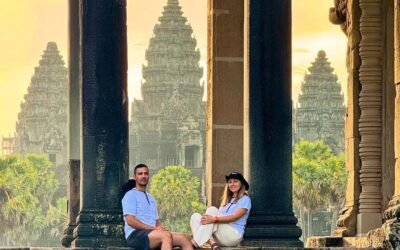
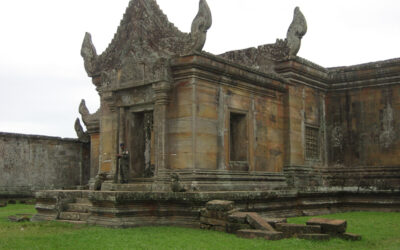
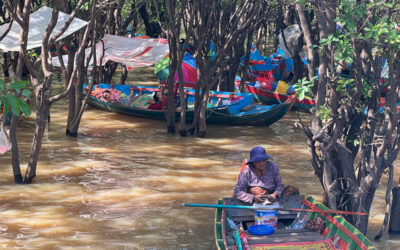
Siem Reap is a bustiling tourist attraction due to its proximity to the Angkor Temple Complex, the world's largest religious monument and a designated World Heritage Site. Angkor Wat is probably the most well-know ancient capital of the Khmer empire, along with Bateay Srei, the fabled pink temple for women, Ta Promhm with its stone hallways and the many gigantic faces of Bayon Temple.There are more than 100 monuments of which two dozen are major temples.Besides the temple complex, the floating Village on Tonle Sap lake is definitely worth a visit.Siem Reap is a thriving tourist destination whose hotels enjoy high occupancy rates.
|
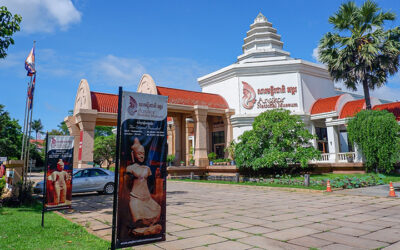
The newly opened Angkor National Museum in Siem Reap promises eight chronologically ordered galleries of Angkorian-era artifacts and multi-media presentations of Angkorian history and culture. The Museum had just opened its doors and was not quite completed at time of printing, but should be very soon. Admissions price: US$12 (for foreigners). $2 for a camera. Hours: 9:00AM - 8:00PM. Located in town, on the road to the Angkor Park.
|
Cambodia's premier pediatric teaching hospitel is providing world quality health care and treatment absolutely free to Cambodian children. Cash and blood donations are always welcome.Tel:063-963409 Fax:063-76045 Website:www.fwab.org
|
Dr.Beat Richner plays Bach on the cello and speaks about the activities of his children's hospiitals (JayavarmanVII in Siem Reap,Kantha Bopha 1 and 2 in Phnom Penh) every Friday and Saturday evening at 7:15PM. Performances are held at the Jayavarman VII Hospital.Located on the road to Angkor Wat.Dr. Richner provides and entertaining and worthy Saturday evening. The hospital welcomes both monetry and blood donations. Website:www.beatocello.com
|
Silk Weaving: Silks like Hol, Pamuong, Sampot Alounh, Saron, Kniew and Krama are Produced in Vibarat Colurs.They adorn many specialist shops in Phnom Penh and Siem Reap .This Cambodian handicraft has been passed on from generation to generation. To watch weavers in action make a trip to Artisans dA'ngkor. - Silk Farm Angkor Silk Farm presents the grand tour of an 8-hectare site, to discover silk farming with specialized guides. Discover the various stages involved in silk production, from mulberry tree chards, to silkworm breeding, the spinning mill and the weaving process
- Les Artisans D' Angkor Chantiers-Ecoles A complete visit of Arts and school will take you through the various training and production workshops of the Chantiers-Ecoles. Discover the traditional techniques used for wood sculpting, stone carving, lacquer work, polychromy and stone patina work, with the explanations of our experienced guides. http://www.artisansdangkor.com/
|
The Cambodian Cultural Village, also named “Cambodia in miniature” is a very interesting gathering of several minority groups in Cambodia, 11 villages in total. All villages feature houses of different architectural styles and dance and traditional wedding performances. The Cambodian Cultural Village also hosts a wax museum and miniatures of famous historical Cambodian buildings and structures. The cultural village is a perfect way to spend an afternoon learning more about Cambodia if you don’t have the time to explore Cambodia by yourself.
This Theme park opened in 2003. It houses a cultural exhibition centre set in pleasant gardens with models of famous sights in Cambodia .
The Shows go on from 2pm through to 7:30
|
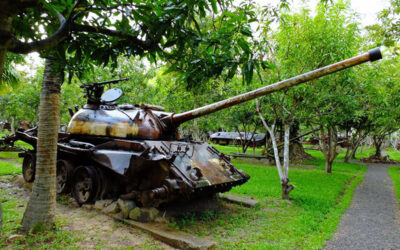
War Museum On the airport road. Cuns, mines, military hardware, artillery pieces and old tanks are on display, The museum opens from 8h00am to 5h30pm.Combine with a trip to the silk Farm and Western Baray. Mine Museum Founded by Aki Ra, a former soldier and de-miner, this museum has become one of the most fascinating cultural attractions in south-est Asia.It documents the story of AkiRa's personal survial through a quarter of a century of war and houses one of the world's larest collections of decomissioned mines and other ordnance
|
Flowers and cense are sold to the constant flow of visitors paying homage. Just down the road a fww meters the shrine to Yeap Tep is located in the middle of roundabout under a large tree.
Yeay Tep: Is a local spririt and this shrine is a fine example of the animistic beliefs that survived the arrival of Buddhism in Cambodia. Animism is still practiced in rural areas. This temple dates back to the 18th century.
|
The AAD helps disabled Cambodians to start small businesses and sell crafts and souvenirs round the old market area in Siem Reap. Music training is given to adults and children of these families to give entertainment to tourists. many of the children of these disabled adults live by begging; so the AAD helps with their education and gets them out of the cycle of despair. A number of families use hand propelled bicycle carts to sell guide books and souvenirs around the Psar Chas market in Siem Reap A literacy program is available every morning for those who need or want to learn to read and write Cambodian language. One teacher has been employed to teach traditional dance to the children. One music teacher is employed to teach the music and the playing of musical instruments.
AAD has now become a local Khmer Association with a Khmer project director. All funding so far has come from donations within the community and donations from tourists.
|